
CJC-1295 + Ipamorelin: The Burger and Fries of Peptides
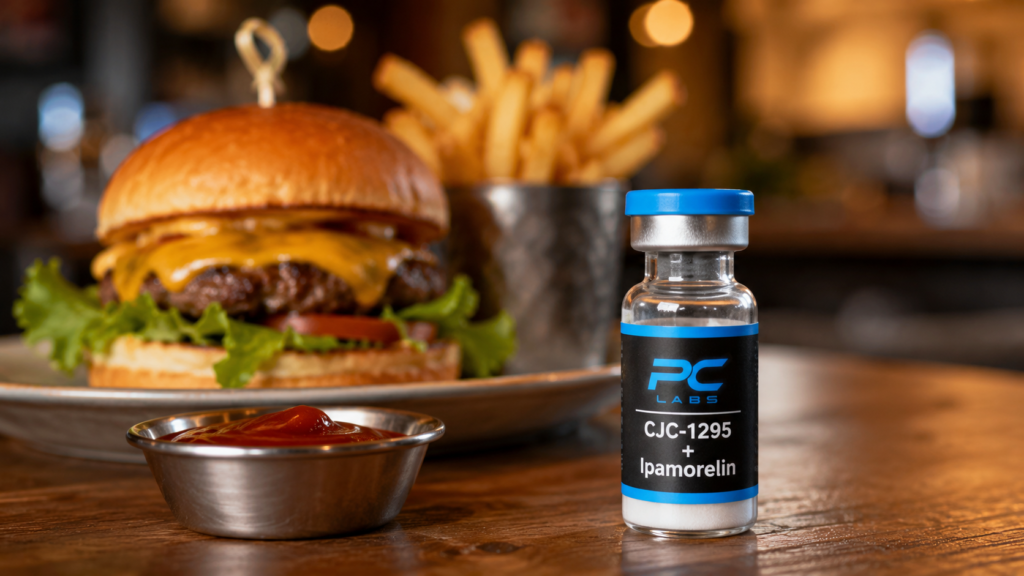
Some combinations just belong together. Burgers and fries. Coffee and mornings. Training and recovery.
In the world of peptide research, CJC-1295 and ipamorelin have developed the same kind of reputation. They are commonly paired because they send two different signals toward the same system: the body’s natural release of growth hormone.
What Is CJC-1295?
CJC-1295 is designed to act like growth hormone-releasing hormone, usually shortened to GHRH. In simple terms, it sends a message to the pituitary gland telling it that the body is ready to release growth hormone.
Ipamorelin approaches the same system from another direction. It interacts with the growth hormone secretagogue receptor and encourages the pituitary gland to release stored growth hormone. Human research has shown that ipamorelin can produce a short and measurable growth hormone pulse (Gobburu et al., 1999).
That is why CJC-1295 and ipamorelin are often used together in research discussions.
CJC sends the invitation. Ipamorelin gets the party started.
Burger and fries.
Why Are CJC-1295 and Ipamorelin Paired?
The science behind the combination is based on two complementary signalling pathways.
Earlier human research found that combining GHRH with a growth hormone-releasing peptide produced a considerably larger growth hormone response than either signal achieved alone (Bowers et al., 1990). That study did not examine this exact CJC-1295 and ipamorelin blend, but it helps explain why the pairing has become so popular.
Growth hormone and IGF-1 are involved in protein metabolism, tissue maintenance and body composition. Growth hormone release is also closely linked with sleep, with one of the body’s largest natural pulses normally occurring overnight.
A human study of CJC-1295 found significant increases in circulating growth hormone and IGF-1, confirming that the peptide can activate the growth hormone pathway (Teichman et al., 2006).
This is why people searching for information about CJC-1295 benefits, ipamorelin research, sleep, muscle support, recovery and healthy ageing often find the two peptides mentioned together.
What Have Women Reported?
One particularly interesting paper examined how women discussed CJC-1295 online.
Van Hout and Hearne (2016) analysed 23 internet discussion threads involving female users. Women described using CJC-1295 in connection with weight management, muscle development, sleep, injury recovery, joint mobility and younger-looking skin.
However, this was not a controlled clinical trial. It was a netnography, meaning the researchers analysed real online conversations and user experiences.
The study tells us what women were seeking and reporting, but it does not prove that CJC-1295 caused every benefit discussed. The researchers also highlighted uncertainty around dosing, long-term effects and differences in female growth hormone patterns (Van Hout & Hearne, 2016).
The Bottom Line
The burger-and-fries comparison works because CJC-1295 and ipamorelin target the growth hormone system through different but complementary signals.
The research supports their ability to influence growth hormone release. Claims involving better sleep, faster recovery, muscle growth, improved skin or mood remain promising areas of interest rather than outcomes proven by large clinical trials.
In other words, this may be one of the most recognisable combinations in modern peptide research—but education should always come before hype.
References
Bowers, C. Y., Reynolds, G. A., Durham, D., Barrera, C. M., Pezzoli, S. S., & Thorner, M. O. (1990). Growth hormone-releasing peptide stimulates growth hormone release in normal men and acts synergistically with growth hormone-releasing hormone. The Journal of Clinical Endocrinology & Metabolism, 70(4), 975–982.
Gobburu, J. V. S., Agersø, H., Jusko, W. J., & Ynddal, L. (1999). Pharmacokinetic-pharmacodynamic modeling of ipamorelin, a growth hormone-releasing peptide, in human volunteers. Pharmaceutical Research, 16(9), 1412–1416.
Teichman, S. L., Neale, A., Lawrence, B., Gagnon, C., Castaigne, J.-P., & Frohman, L. A. (2006). Prolonged stimulation of growth hormone and insulin-like growth factor I secretion by CJC-1295 in healthy adults. The Journal of Clinical Endocrinology & Metabolism, 91(3), 799–805.
Van Hout, M. C., & Hearne, E. (2016). Netnography of female use of the synthetic growth hormone CJC-1295: Pulses and potions. Substance Use & Misuse, 51(1), 73–84.
SEO title: CJC-1295 and Ipamorelin: Benefits, Research and How They Work Together
Meta description: Learn what CJC-1295 and ipamorelin are, how they influence growth hormone signalling, why they are commonly paired and what female users have reported.